





































For many US companies, outsourcing has become a go-to strategy for streamlining their operations, cutting costs, and enhancing overall business performance. To ensure that this arrangement works for your business, you need to determine the return on investment (ROI) and scrutinize if the partnership with your outsourcing provider works to your advantage.
This article explores how to measure success and the ROI for outsourcing services, as well as ways to maximize your investment. This also emphasizes the importance of partnering with reputable companies like Big Outsource to help maximize your investment.
Why You Need to Measure ROI Metrics
Companies that decide to outsource should know it requires investment in financial and operational resources. Because of this, your company must carefully measure the ROI metrics of their outsourcing operations to justify and ensure your success on different factors. This involves balancing costs and benefits to determine whether outsourcing is giving you the expected results and adding value to your company’s profitability.
The ROI calculation is a crucial activity to justify your outsourcing decisions. It provides clear evidence of the financial impact of outsourcing, allowing for cost savings and additional revenue. It also helps identify areas for improvement and aligns with strategic goals.
Continuous monitoring of ROI can reduce risks, such as hidden costs or cultural differences. This measure can also foster a culture of continuous improvement, promoting dialogue and collaboration between the company and provider to identify areas for optimization, streamline processes, and further improve the overall value of the outsourcing initiative.
Key Metrics for Measuring Outsourcing ROI
To effectively measure the outsourcing ROI, you have to track a variety of metrics that reflect the full impact of this staffing strategy on your business. Here are some key metrics you should consider:
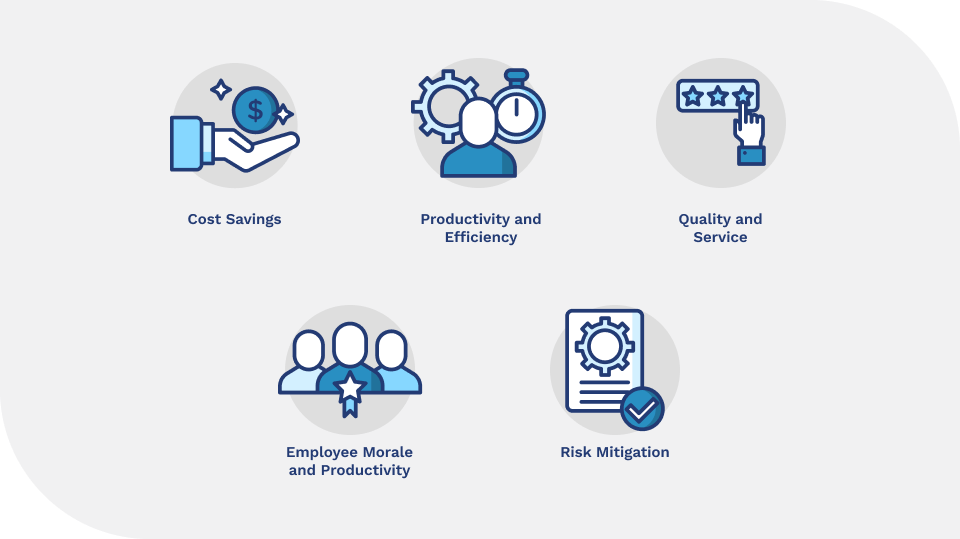
Cost Savings
The main reason companies choose to outsource is usually cost savings. Cost savings are calculated by comparing in-house versus outsourced operations for direct expenditures, including labor, technology, and infrastructure.
Labor Costs
- In-house: You need to consider salaries, benefits, payroll taxes, and other costs of hiring workers to perform a specific function, (say payroll processing).
- Outsourced: You only need to pay for the service fee, which is most likely cheaper as the tasks are done in countries with cheap labor.
Technology costs
- In-house: You need to shoulder software licenses, hardware, maintenance, upgrades, and IT support expenses.
- Outsourced: The provider usually includes these charges in their service fees.
Costs of infrastructure
- In-house: The costs include maintenance costs for your team’s office space, utilities, equipment, and other resources.
- Outsourced: The provider provides them, saving your organization money.
Indirect Costs
- In-house: Your business can also incur indirect costs like recruitment, training, and management overhead.
- Outsourced: Outsourcing also has indirect costs like communication challenges, cultural differences, or potential quality control issues. to account for these when evaluating overall cost savings.
Productivity and Efficiency
Outsourcing enables firms to focus on their strengths while delegating non-core tasks to experts. This, in theory, will improve your efficiency and production. To find out if your operations achieve efficiency, you can look at metrics such as production cycle times, output rates, and time-to-market.
- Production cycle times: The time it takes to execute a task or procedure from start to finish. This includes all steps, and activities, including any delays or bottlenecks. Outsourcing certain tasks may streamline procedures and minimize cycle times for your firm.
- Output Rates are the number of outputs or tasks done in a given time. This metric measures work volume. With specialized experience and refined processes, outsourcing can enhance your company’s output.
- Time-to-Market: It refers to the time it takes to launch a new product or service, from concept to launch. Outsourcing helps your organization create and launch products faster by providing specialized talents and efficient processes.
Quality and Service
Outsourced service quality can impact business operations and customer satisfaction. Vital metrics for measuring quality include error rates, service delivery times, and quality standards compliance.
- Error Rates are the percentage of errors or flaws in output or deliverables. The outsourced functions may have faults in data input, customer service, product manufacture, or other areas. Explicit quality requirements and close error monitoring are necessary to ensure the outsourced provider meets expectations.
- Service Delivery Times are the outsourcing provider’s task or service completion times. Examples of these are response times for customer inquiries, turnaround times for processing orders, or project completion timelines. Timely service delivery is critical for maintaining customer satisfaction and ensuring smooth business operations. Delays can lead to frustration, missed deadlines, and potential loss of revenue.
- Compliance with Quality Standards is how well the outsourcing provider follows industry-specific quality standards, regulatory regulations, and business quality rules. Compliance guarantees that outsourced services satisfy quality, safety, and regulatory requirements.
Employee Morale and Productivity
While often ignored, the effect of outsourcing on in-house staff morale and productivity plays a significant role in ROI. Factors, such as employee satisfaction, turnover, and productivity can reveal how outsourcing affects your staff.
- Employee Satisfaction is a measure of how content and fulfilled employees feel with their jobs. It includes work-life balance, salary, growth opportunity, and purpose. Outsourcing can boost or lower employee satisfaction depending on implementation and communication.
- Turnover Rate is the percentage of employees who leave the company within a specific period, usually calculated every year. High turnover may imply low morale, unhappiness, or growth potential. Outsourcing that causes job losses or uncertainty can increase turnover. Outsourcing can improve retention by freeing up staff to work on more demanding and rewarding duties if managed well.
- Productivity is a measure of the efficiency and output of employees, often evaluated through metrics like output per employee, project completion rates, and team performance. Outsourcing lets internal teams focus on their strengths and outsources mundane or specialized duties to professionals, increasing productivity. However, productivity must be monitored to keep staff engaged and motivated despite a reduced workload.
Risk Mitigation
Risk reduction is another significant factor in computing the ROI from outsourcing. Access to qualified skills, cutting-edge technology, and scalable solutions helps reduce operational risks when outsourcing. Incident rates, compliance ratings, and contingency planning performance are some metrics that can determine the success of outsourcing risk mitigation.
- Incident Rates measure outsourced function incidents and disruptions. System outages, service interruptions, security breaches, and other incidents that affect the company’s operations are examples. An effective outsourcing arrangement should reduce incident rates since the provider contributes experience and methods to prevent and resolve difficulties. Monitoring incident rates helps analyze the provider’s risk management and business continuity.
- Compliance Ratings indicate how well the outsourced provider follows industry, legal, and internal compliance norms. Non-compliance can lead to financial penalties, legal action, and reputational damage. Companies should audit and analyze providers to ensure compliance.
- Emergency Planning Performance is how well the provider’s contingency and disaster recovery strategies handle unforeseen situations. A well-prepared supplier should have detailed preparations to handle unexpected events and minimize their impact on operations. Regular testing and drills assess the provider’s business continuity readiness and capacity to handle difficulties.
Best Practices for Calculating Your Outsourcing ROI
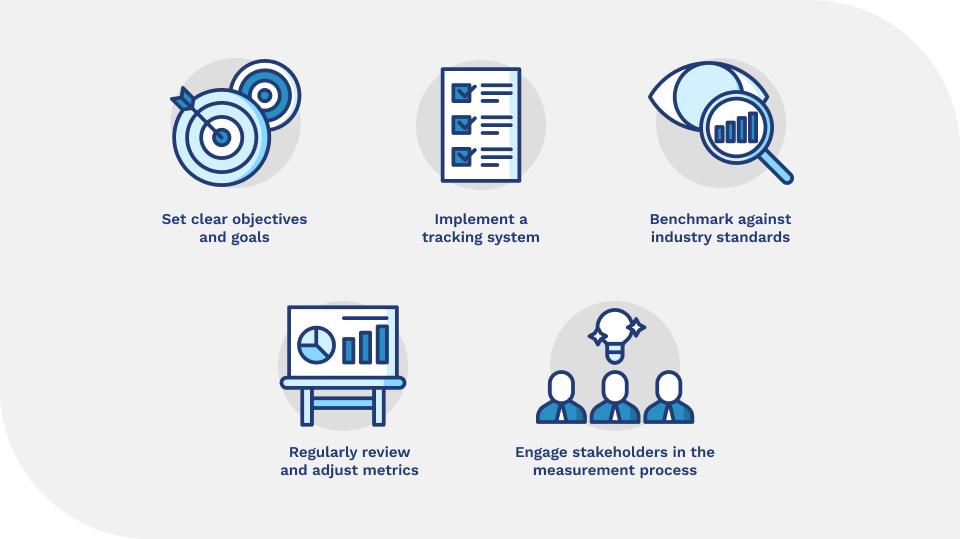
To successfully monitor and optimize the ROI of outsourcing, you may need to implement these best practices:
Set clear objectives and goals
Before outsourcing, it is critical to establish clear objectives and goals that are consistent with your business strategy. Having well-defined goals, whether they are for cost reduction, quality improvement, or time to market, will give a baseline against which ROI may be measured.
Implement a tracking system
A reliable tracking system is required for monitoring the performance of outsourced services and collecting important data. This system should be able to measure critical parameters in real time, offering actionable insights into the success of your outsourcing plan.
Benchmark against industry standards
Benchmarking your outsourcing performance against industry norms lets you assess your competitiveness and discover opportunities for improvement. Regularly comparing your data to those of your sector counterparts might uncover ways to improve efficiency and ROI.
Regularly review and adjust metrics
Outsourcing is not a set-it-and-forget-it strategy. Regular monitoring and adjustments of your metrics ensure that your outsourcing efforts remain in line with changing business requirements. This method allows you to continuously fine-tune your outsourcing strategy in order to maximize ROI.
Engage stakeholders in the measurement process
Involving important stakeholders, such as finance, operations, and IT departments, in the ROI measuring process allows for a thorough examination. Stakeholders can contribute useful insights and viewpoints, assisting in identifying the relevant costs and advantages connected with outsourcing.
Partnering with Experts: Boosting Your Outsourcing ROI with Big Outsource
Knowing how to measure the success and ROI of outsourcing goes beyond basic cost comparison. Companies can acquire a comprehensive understanding of the impact of outsourcing by taking into account measures like efficiency, quality, employee morale, and risk mitigation.
Companies can maximize their investment returns by setting clear targets, adapting thorough tracking, comparing against industry standards, analyzing metrics regularly, and integrating stakeholders in the outsourcing process.
Partnering with renowned outsourcing businesses such as Big Outsource allows you to successfully harness the benefits of outsourcing, resulting in increased growth and overall business performance.
Without clear metrics, it’s hard to know if outsourcing is saving costs, improving efficiency, or simply draining resources.
Schedule a consultation with Big Outsource on how to ensure your outsourcing initiatives will get the best returns.


